
Is In-Floor Heating Worth It in a Calgary Home?
Where hydronic in-floor heat pays off in a Calgary winter, and where it does not.
Short answer: In the right spots, yes. Hydronic in-floor heating is one of the most comfortable ways to heat a room in a Calgary winter, and it pays off most in basements, bathrooms, garages and rooms over garages. Whole-home in-floor heat is a bigger commitment that makes the most sense in new builds and major renovations, where the floor is already open.
Warm floors change how a room feels more than almost anything else. The question is where that comfort is worth the cost of getting tubing into the floor.

How does hydronic in-floor heating work?
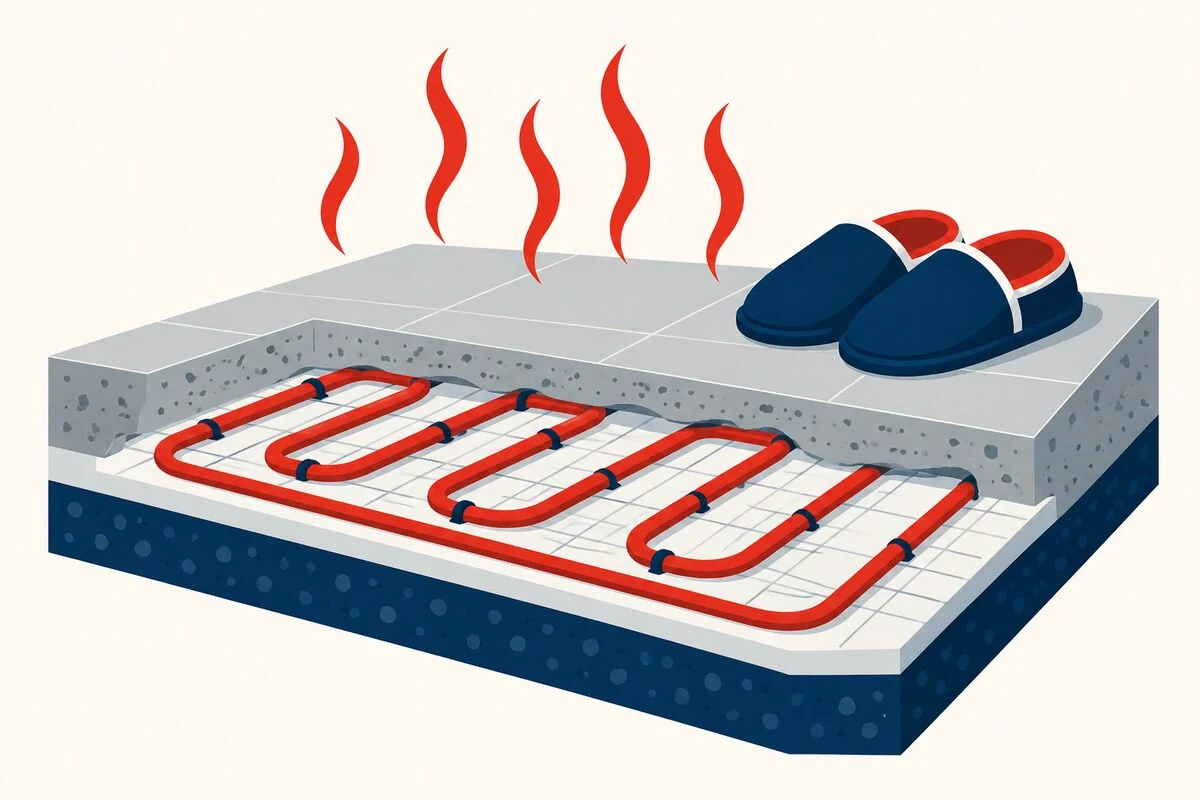
Warm water from a boiler, or in some smaller setups a water heater, circulates through PEX tubing set in or under the floor. The floor warms up and heats the room from the ground up, quietly and without blowing air. Each area can have its own thermostat. Electric mats are a separate option for small spaces like a single bathroom.
Where does it pay off?
| Space | Why it works | Fit |
|---|---|---|
| Basements | Concrete floors are cold, and in-floor heat fixes that at the source | Excellent, especially during a basement development |
| Bathrooms | A warm tile floor is something people notice every day | Excellent during a renovation |
| Garages and shops | Steady, even heat without blowing dust around | Excellent when the slab is being poured |
| Rooms over a garage | The floor is the cold surface | Good when the floor is open |
| A finished main floor, retrofit | Means pulling up flooring | Think twice unless you are already renovating |
| Whole new home | Can be designed in from the start | Good, if planned at the drawing stage |
What does it take to add in-floor heat?
- A heat source. Usually a boiler, sized for the area being heated.
- Tubing in the floor. Cast into a new slab, set in a thin pour over an existing floor, or fastened under the subfloor from below.
- Controls. A manifold, pumps and thermostats for each zone.
- A permit. In Calgary, installing or altering a hydronic heating system needs a hydronic permit, plus a gas permit for a new boiler.
The trade-offs
- Comfort: very even, quiet heat with no drafts or dust.
- Response time: slower to warm up and cool down than forced air, so it works best on a steady setting.
- Cooling: it does not cool. Homes that want air conditioning still need ducts or a separate system.
- Cost: more up front than adding a duct run, which is why it pays off most where the floor is open anyway.
Common questions
Is in-floor heating expensive to run in Calgary?
A well-designed hydronic system with a modern boiler runs efficiently, and many people set the thermostat a little lower because the room feels warmer. The up-front install is the bigger cost.
Can in-floor heat be added to an existing home?
Yes, especially in basements and during bathroom or flooring renovations. Retrofitting a finished main floor is possible but means lifting the flooring.
Does in-floor heating work with tile, hardwood and carpet?
It works best with tile and stone. Many engineered wood floors work too. Thick carpet and underlay slow the heat down.
Related guides
Ready when you are.
Tell us what is going on and the Northern Flame team will get back to you within one business day.
Get a Free Quote